
By Stu Strasner, CFA
What Happened
There has been a great deal of complacency in the stock market recently. When a market runs in one direction for a long time, market participants tend to extrapolate that behavior into the future. Two other things usually happen along the way: momentum strategies become widely adopted, and leverage increases.
Both have been on full display during this rally:
- Momentum (trend following): These strategies buy a security simply because it has gone up, on the expectation that it will keep going up.
- Leverage: There has been an explosion in exchange-traded funds that let investors bet on the price of a single stock, and the kicker is the 2x or 3x leverage that magnifies the bet in either direction.
When the market turns down after a long run upward, these two strategies can exacerbate the decline in the same way they inflated the gains on the way up.
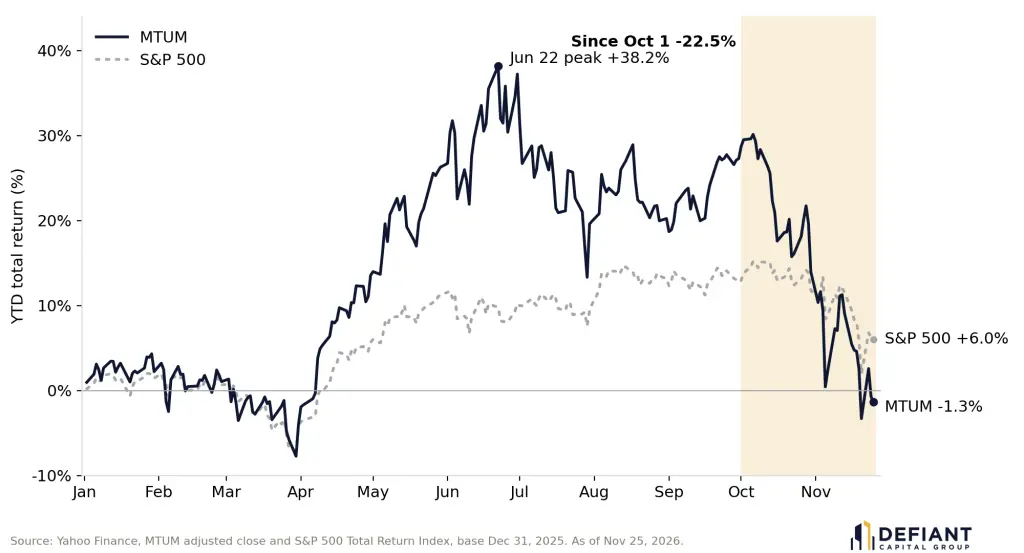
The iShares MSCI USA Momentum Factor ETF (MTUM) shows how quickly that can happen. It was up 38.2% for the year at its June 22 peak, gave back 15.0% over the past month, and is now down 1.3% for the year.
Momentum vs. S&P 500 year-to-date total return, October 1 onward highlighted
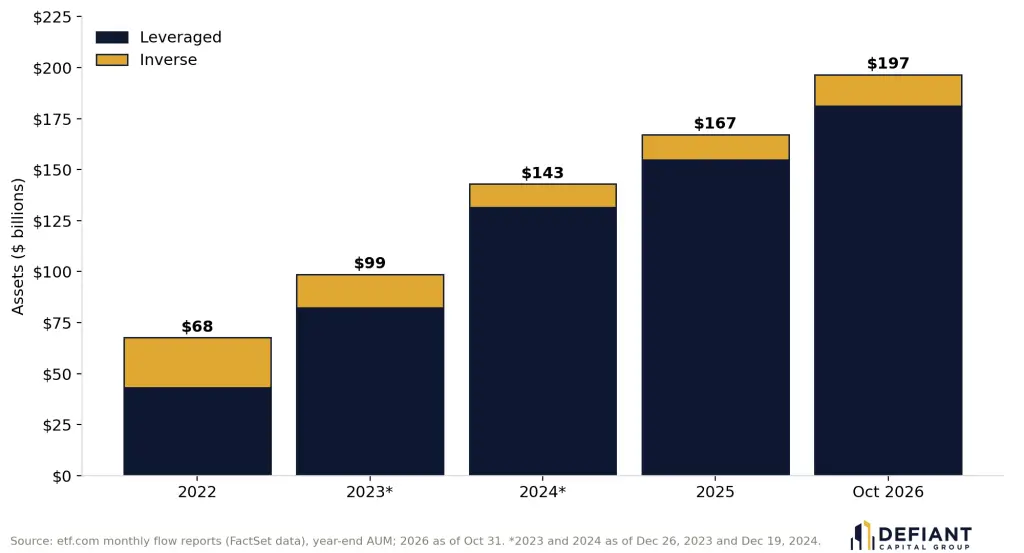
The leverage side of the story is just as visible. Assets in US-listed leveraged and inverse ETFs have nearly tripled since the end of 2022, from about $68 billion to $197 billion at the end of October. Leveraged assets alone have more than quadrupled over that stretch, while assets in inverse funds have actually shrunk.
Assets in US-listed leveraged and inverse ETFs, 2022 to present
Two Events Worth Watching
Two recent events have the potential to change the near-term outlook:
- The blue wave: The midterm elections returned both houses of Congress to the Democrats.
- Nvidia: The board reinstated Jensen Huang as CEO, less than a week after saying it did not intend to bring him back.
I believe these two events are intertwined. Nvidia has been the chief cheerleader and investor in the AI trade. In announcing the reinstatement, the company disclosed that its board received input from senior levels of the U.S. government, and the incoming Congress could investigate whether the White House pressured the board.
In the short term, Huang’s return will probably boost the AI trade. In the longer term, it could become a negative if the company is dragged through a prolonged period of external examination.
Why It Matters
This matters because the market has become highly dependent on the AI trade for earnings growth, and the wealth effect of the stock market is a powerful force in the economy.
The upper-income households that have been sustaining consumer spending are significantly influenced by that wealth effect, so a stumble in AI stocks would likely not stay confined to portfolios.
How I Am Positioning
In my view, this backdrop argues for a more balanced posture rather than a wholesale shift. For clients whose equity allocation has drifted above target after the long run, using rallies to rebalance toward their long-term allocation and gradually adding to fixed income appears prudent.
I am not predicting the end of the rally, and I continue to believe stocks belong at the core of long-term portfolios. The aim is to keep portfolios from becoming more dependent on a single trade than clients intend.
Because the inflation outlook is far from certain, I see value in adding to two complementary types of bond exposure over time:
- Floating-rate loans: Loan ETFs with near-zero duration reset their income as short-term rates move, which may help if inflation stays sticky, though they carry credit risk that should be sized accordingly.
- Traditional fixed income: Core, high-quality bonds with more duration can provide ballast if growth slows and equity markets weaken.
As always, the right mix depends on each client’s goals, time horizon, and tax situation.
Please see important post dislcaimers here.